Archive for the ‘social security benefits’ Category

Social Security Benefits—How to Get a Bigger Check

Monday, March 9th, 2009

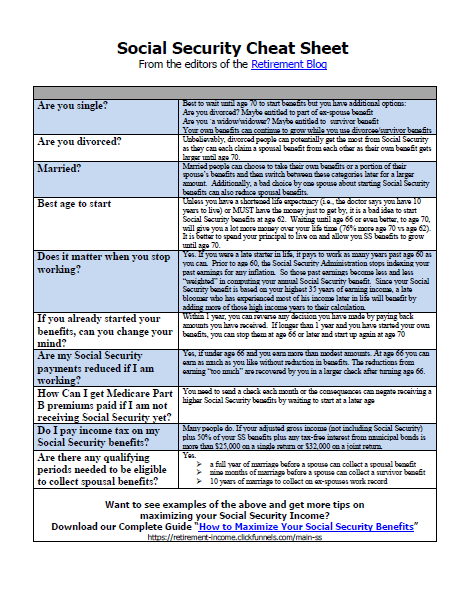
Sure you can start your social security benefits at age 62, but is that wise?  In most cases not.  In most cases, given average life expectancy, you earn more by waiting until your full retirement age to start benefits.  If you’re married, you have even greater flexibility and opportunities to get higher social security benefits.

One set of researchers found that for married couple, having the lower-income spouse start benefits at age 62 and for the higher income spouse to defer benefits to age 70.    The lower income spouse should start as early as possible because their “penalty” for starting early disappears when the higher income spouse dies (the lower income earner can then collect the deceased’s benefits).

Another little know tactic is the “file and suspend” provision.  This allows the higher income earning spouse to file for benefits at his full retirement age yet suspend the actual collection of benefits until later. The suspension of collecting benefits allows the benefit to grow through age 70.  Yet, as soon as the higher income spouse files, the lower income spouse may start collecting benefits at 50% of the higher income earner’s rate.

If your situation changes after you begin benefits, you can exercise the little know “do-over” provision.  In such a case, you pay back all of the social security benefits you have received (without interest!).  You can then re-file when you want your benefits to start thereby allowing you or a spouse to collect more.  If you have no problem sending the government a large check, you may want to start your benefits at age 62 knowing that you can always exercise the do-over provisi0on and reverse your earlier filing.

You can use this limited information above to tell if your retirement advisor is any good.  Most financial advisors know little about social security because there’s nothing for them to “sell.”  Knowledge of social security won’t make then any commissions.  However, more competent fee-based retirement planners will charge a fee for their time in analyzing your social security options and help you maximize the decisions and get thousands more in your pocket.

Listen to this post Listen to this postShare This Post

Spouse’s Early Retirement May Lower Other Spouse’s Social Security Benefits

Tuesday, January 20th, 2009

Traditionally, about 50% of people eligible to collect Social Security at 62 do so. But if you do, you’ll receive about 25% less income (i.e. Social Security benefits) than waiting until your full retirement age – between 65 and 67 depending on your birthday. What implication does your early retirement have on your spouse?

Everyone whose work earnings make him or her eligible for Social Security benefits (i.e. income) receives his full Social Security benefit when he reaches his full retirement age (FRA). You can retire as early as 62 but your benefits will be permanently reduced by about 25% from the full benefits you’d get at your FRA. Waiting longer than your FRA to begin receiving Social Security benefits increases your benefits. Waiting to age 70, will increase them by about 32%.

A spouse (i.e. a married person) always has the option of taking the larger of her own working benefit or a ‘marriage entitlement’ benefit that’s based on the benefit her husband collects (assuming the husband was the higher earner in this example).

A spouse’s benefits while husband is alive
Since men generally have worked and earned more, it’s their wives that are in the position of collecting the larger of their own working Social Security benefits or their social security spouse’s benefit.

 A wife’s spousal benefit can be as high as 50% of her husband’s full retirement benefit. To receive this, she must wait for her own FRA and he must do the same.

If he retires early, but she waits for her FRA, she still get 50% of her husband’s benefit – but his is less because his benefit is reduce due to his early retirement. If he retired at 62, his benefit would be reduced by about 25% from his FRA benefit.

If she retires early at 62, and he waits for his FRA, her spousal benefit will be a reduced about 30% below whatever her 50% spousal benefit would have been. 

A surviving spouse’s benefit
A surviving spouse is entitled to the greater of 100% of the deceased spouse’s social security benefits or his/her own working benefit. As stated above, this option is more typical for a surviving wife to make.

Here, the wife’s 100% of her husband’s benefit is affected by what he actually received. So if he retired early, then her 100% benefit will be smaller to the same extent that his benefit was reduced for early retirement. Her 100% benefit would increase if he delays his retirement to age 70.

So a married man’s decision when to collect Social Security has direct implications not only on how much he’ll receive in Social Security benefits, but how much his wife and survivor will receive. But remember, there’s more to life than financial gain, men don’t live as long as women; they deserve some decent retirement time too.

Listen to this post Listen to this postShare This Post

How Early Retirement Impacts your Social Security Benefits

Monday, December 29th, 2008

Thinking about early retirement before you start collecting Social Security Benefits?

Doing so won’t reduce the benefit that you accrued before you stopped working—but it could produce a smaller benefit than your estimated benefits statement suggests. You should receive an estimated-benefits statement from the Social Security Administration each year. The benefits it projects assume that you continue working to the retirement ages listed (62, 66 and 70) at your current salary.

For example, your statement might say something like, “If you continue working until your full retirement age (66 years), your payment will be X.”

But, what if you’re not working, and don’t plan to work again before applying for Social Security benefits? Will you receive the benefit your estimated benefits statement shows, or will it be reduced?

To answer that question, you have to understand how Social Security benefits are calculated. They’re based on earnings over your entire career, with income from past years adjusted for inflation. When calculating your benefits, the Social Security Administration looks at the 35 years with the highest adjusted wages. If you have more than 35 years of earnings, your lowest earning years are dropped. If you have fewer than 35 years of earnings, one or more of the figures used in the calculation will be zero.

Now, to determine future earnings, Social Security looks at your last two years of income. The problem is, if your statement is prepared in the first six to nine months of the year, your earnings for the previous year won’t be included, so the Social Security Administrator will use uses your earnings from the year before as your earnings for last year, this year, and future years. So, in essence, retiring before you start collecting Social Security won’t reduce the benefit that you accrued before you stopped working—but it could produce a smaller benefit than your estimated benefits statement suggests.
To get a more precise prediction of future payments based on your recent past, you can request an updated statement from Social Security by filling or use our social security calculator.

Listen to this post Listen to this postShare This Post