One significant source of income tax relief for taxpayers in the lowest 2 tax brackets is the elimination of both the long-term capital gains tax and qualifying dividend* tax through 2012. This income tax relief pertains to the 10% and 15% tax brackets in which numerous retired people find themselves.
Long term capital gains tax - to which the income tax relief pertains - applies to any asset you are liquidating that you've held for at least one year. The amount taxed will be the difference between the sales price and your tax basis (in most cases, the basis is the amount you paid). Short term capital gains income tax rates will be the same as your ordinary revenue tax rate (short term applies to items being sold within a year of purchase).
Regarding the table below - according to 2012 tax brackets - you may have a fairly healthy income and nonetheless remain in the lowest 2 tax brackets.
So, according to the 2012 income tax rates, anybody fling their taxes as single having a gross income of $45,100 or less will be eligible for the 0% capital gains and qualified dividend tax rate while those filing married jointly can have up to $90,000 gross income and also enjoy the 0% rate on gains and qualifying dividends. This income tax relief is therefore generously available so be sure to take advantage of this generous income tax relief as it ends 12/31/12.
| Tax Bracket |
Filing Status |
Highest Taxable Income | Personal Exemption |
Standard Deduction |
Gross Income |
| Equal to or less than 15% bracket | MFJ | $70,700 | $7,400 | $11,900 | $90,000 |
| Equal to or less than 15% bracket | Single | $35,350 | $3,800 | $5,950 | $45,100 |
Anybody who has had a substantial rise in their investment through the years would usually be subject to long term capital gains tax. To take advantage of the final year of the capital gains income tax relief in 2012, he should sell the investment and capture the gain at 0% tax. If he's still wants to own it, then he can purchase it again. The advantage of this tax technique is to re-established his the investment holding with an increased tax basis - to the investment's present market value. So in the foreseeable future when gains are achieved, he'll possess a higher tax basis and therefore minimize future taxes.
*a qualifying dividend is a dividend that comes from shares that you must have held for more than 60 days during the 121-day period that begins 60 days before the ex-dividend date. The ex-dividend date is the first date following the declaration of a dividend on which the buyer of a stock is not entitled to receive the next dividend payment. When counting the number of days you held the stock, include the day you disposed of the stock, but not the day you acquired it.
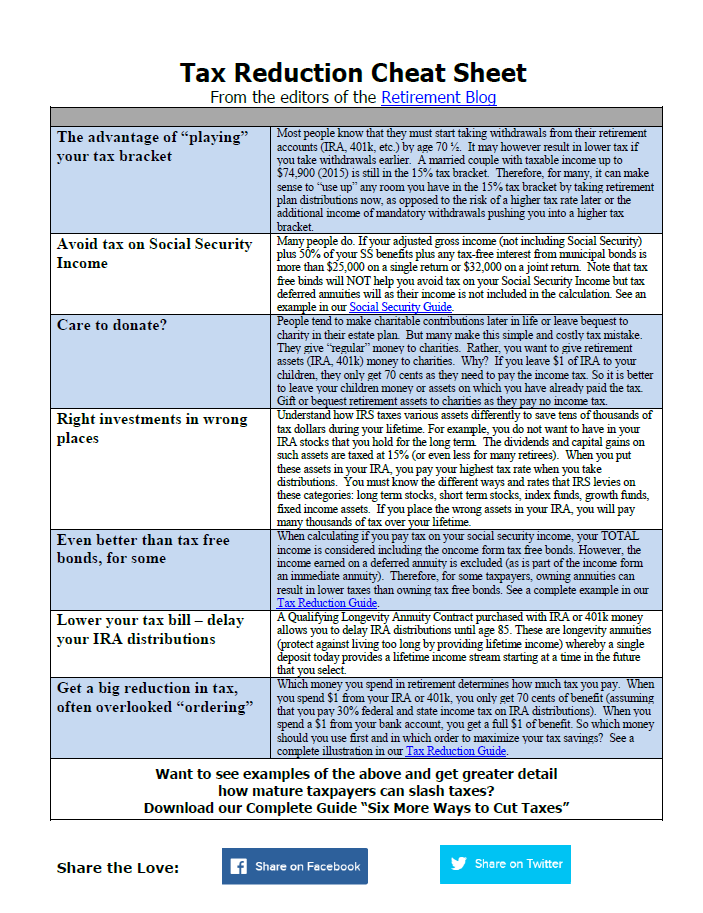
You Pay More Taxes Than Necessary
And we guarantee your CPA has never told you The problem with paying taxes is that most people overpay. So if you are concerned about having enough in retirement, you must stop overpaying taxes. I know you think your CPA takes care of this for you. WRONG. I AM a CPA (retired) and I can tell you that 90% of CPAs do nothing more than enter your information into the little boxes on the tax return but NEVER tell you how to pay less next year. Why? Many of them simply do not know what we can show you. In ten minutes.Get Your Copy Now - 6 Ways to Cut Retirement Taxes






It's sound really good that 2012 is a last year of income tax.