If a recession becomes severe, dollars may suffer from deflation rather than inflation. This would change the rules you have for retirement investing over the past 30 years. What should retirees consider doing if deflation sets in?
We're familiar with the effects of inflation. Our dollars just don't buy as much as they used to. Too much 'easy money' from too much credit puts more dollars into everyone's hands so each dollar is worth less than before. So too many dollars are chasing too few goods and the prices of goods are bid up. In this typical inflationary environment, retirement investing rules are to get rid of cash and hold hard assets like real estate.
But when recession occurs, everyone becomes afraid of consuming. Businesses feel the pinch and people lose jobs. Government may try to 'prime the pump' by offering and instigating low interest rates. That reduces the cost of credit and hopefully to get people to begin borrowing and 'consuming more'.
But if the turn down is too severe, very few people will be enticed to spend money. The money supply actually contracts. The results in a low demand to buy most things and can force prices down. And deflation is the general decrease in the prices of goods. Your dollars are worth more! Rather than get rid of dollars, you want to own them and convert them selectively to assets that have fallen in value (real estate, stocks, etc).
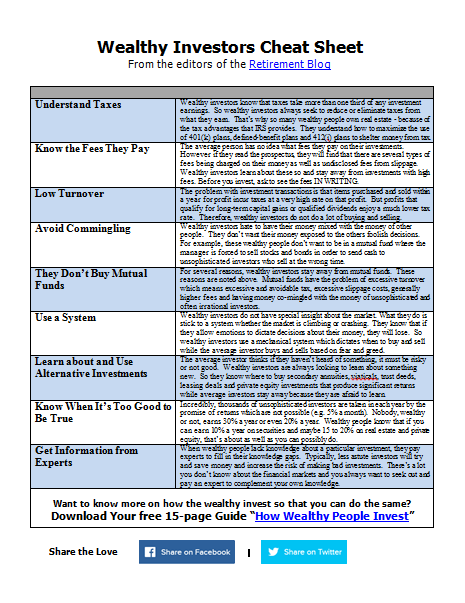
One page "invest like the rich" cheat sheet provides short explanations of how the rich investment differently. You don't need to be rich to copy what they do. Download now.
Most retirees have no job to lose. They're living off Social Security, pensions and their investment earnings. Most of this retirement income may be fixed income. Those in such a circumstance can actually benefit from deflation – mostly from the benefit of lower prices for things.
But under deflation, dollars become more valuable and debt – i.e. owing a fixed amount of dollars – becomes more of a burden. So retirees should reduce the cost of their debt by reducing payments or restructuring.
As deflation sets in you're paying off debt in more expensive dollars. So any way to reduce the dollars you must commit to debt payments is beneficial. Note that it IS NOT a good idea to pay down debt during deflation, --it is a good idea to restructure debt to lower the payments.
Restructure your debt payments. With recessions comes falling interest rates. Take advantage of lower interest rates to restructure debt payments you can't pay off quickly.
Refinance your home. If you have a mortgage, refinance at lower interest rate to cut your monthly costs – or to pay it off over a reduced time period. Or even better, borrow against it with a reverse mortgage.
Since the value of cash is increasing, holding it will increase your wealth – but only during deflation. Aside from preserving your emergency funds, you'll want to hold dollars for retirement investment opportunities at low prices.
If you do have extra cash, stay aware of overly depressed investment prices and commodity prices (oil and gold) that will recover after the recession ends and present low risk retirement investing opportunities. Real estate investments – especially condos – are a typical case. It may even be worth a small remortgage of your paid off house for some investments (this strategy is not suitable for everyone as any borrowing will incur a fixed payment commitment while the return on investments is not assured).






With current real estate prices and tightened credit standards there are some excellent opportunities to buy homes as rentals and create passive income as you wait for home values to rise. I have had no problem renting the homes I have bought and the renters are paying the mortgage AND I have income left over at the same time!
Gold and oil are a great buy when thier is deflation. You get the stock or etf at rock bottom prices. You can make some good money when inflation comes back and some funds pay you to wait. Everyone should have some oil and gold and maybe trusts or reits besides stocks and bonds.
Best etf funds lists last blog post..Gold double long etf.
I agree that real estates can be a good investment in this time. It's a great opportunity but still try to consider if you will love the place.
Is real estate a valid part of a self-directed IRA?
Great article. One thing people need to realize is investing during a depression is all about positioning. While deflation of the dollar will negatively impact the masses, with a little careful planning you can easily put it to work for you. There are industries out there that literally pray for depression because it positively effects their cashflow. Find out what these industries are, put you cash behind them. Thanks for the Read.
When inflation picks up Tips would be a good idea. The payment goes up with inflation.
Insurance Sectors,Real estates,Gold and oil can be a good investment in this time to make our future best.Since the value of cash is increasing, holding it will increase your wealth, although there is lots of deflection in market but these plans are best on retirement.
While there is definitely deflationary pressures on the economy and it is clearly contracting. I am very concerned with all of the borrowing and other economic policy that the fed is incorporating right now. There is a lot of money that is being created and mostly parked on the sidelines as banks are still to timid to loan. However once the economy turns a corner and things start to move, all of this parked money is going to come roaring on to the scene as people feel good about spending again. I feel that at a certain point, deflation will rapidly turn into inflation. I also feel that the inflation that we are going to experience in a few years will be much larger and much more destructive than the relatively small deflation we are experiencing now.
Real estate i think not good investment this days. Gold prices hike up recently. Maybe its best to start thinking self employment rather than depend on company to raise our salary. Its good investment also with starting small business.
With current real estate prices and tightened credit standards there are some excellent opportunities to buy homes as rentals and create passive income as you wait for home values to rise. I have had no problem renting the homes I have bought and the renters are paying the mortgage AND I have income left over at the same time!
If you can find some income from stocks or real estate or use credit to purchase something that pays you then your ahead of deflation. Good post most people do not realize you can use deflation to your advantage.
great post.... I personally think if you have cash your best place is to consume or invest in real estate while its low. There's not a whole lot of things you can buy that is pretty much guaranteed to go up or can at least support its debt service that I can think of. Business are shacky and blue chip stocks are unpredictable. Real estate is the key.
Since inflation is on it's way up because of the massive dollar printing by the FED and low interest rates, buying gold seems to be a great investment these days as a hedge against inflation and a hedge against declining dollar.
This is one of the reasons why having a balanced investment portfolio is a sound idea. Having Real Estate, stocks, bonds, and gold are good as it makes your overall holdings less risky.
William Lemerond here of SLEY Capital Advisors L.P. , , I would like to mention for those planning or getting ready for retirement in a deflationary cycle DO NOT load up on bonds too much. I would suggest decreasing your exposure to government bonds, especially longer term >5 years. If you must still have some safe fixed-income investments go with some BBB or AAA rated corporate bonds. Just remember to not become overexposed to bonds because of your fear and risk aversion that comes with deflationary periods.
I lost a lot of superannuation dollars during the last recession like a lot of people did. Oh wells on track to start building it back up again 🙂
These are some great pointers. There are always some great investment opportunities around during deflationary economic times. It is just a matter of finding one. Real estate is always a great option. When it comes to retirement investments security is the key.
Using any kinds of credits, bank dets are just going to get you into more trouble. It doesnot make any difference I must say!!
Ideally, you should just Go, make payemts at the end of every month and hope that things get better
Investing in real estate is a great retirement plan 🙂
Just be sure to find great deals and the right the properties to invest your money with..
- Kim
A number of commentors above suggest investing in real estate. If predictions of coming deflation are correct, now is NOT the time to purchase real estate. Why? Prices will spiral down. Hold cash, wait for the bottom.
This is a great time to invest in real estate. The economy is only going to get stronger in the next few years. Its time to make the move now.
I have just stumbled upon this site and have found it to be interesting and informative.
I would have to agree with the comment left by medlaw, he is so right i saying that now is just not the right time to buy into property, not with the crises that we are facing, Prices are going to come down yet again, so rather hold onto your money, and sit it out then buy and also this will bring down your mortgage payments too.
Real Estate... Really? Sounds like a lot of real estate brokers and suckers who bought real estate at its peak and are praying for its comeback are on this site.
Bonehead #1
"With current real estate prices and tightened credit standards there are some excellent opportunities to buy homes as rentals and create passive income as you wait for home values to rise. I have had no problem renting the homes I have bought and the renters are paying the mortgage AND I have income left over at the same time!"
Bonehead #2
"I agree that real estates can be a good investment in this time. It’s a great opportunity but still try to consider if you will love the place"
Real estate = Fixed debt service not good see above article.
Rentals = Decreasing rental income, remember deflation.
Real estate values = decreasing, remember DEFLATION
Overall real estate is NOT where you want to be. Many many more foreclosures yet to come over next 5 to 9 years. Values will continue to fall away. Commercial realestate is the next shoe to drop in that sector.
Good luck to all you real estate brokers and suckers!
I am very concerned with all of the borrowing and other economic policy that the fed is incorporating right now. There is a lot of money that is being created and mostly parked on the sidelines as banks are still to timid to loan. However once the economy turns a corner and things start to move, all of this parked money is going to come roaring on to the scene as people feel good about spending again. thanks...
I don't think it's a good idea to gamble with your retirement. The only investment you should be doing is safe stuff, like bonds.
A good sign of stability is the number of unemployment and the housing market. If one does not have a stable job, usually one does not buy a home without a stable job. But if you are those that are fortunate enough to afford buying homes at this time, I would do so and keep it as rentals until the housing market goes up. For me, retirement money does not do me any good. You can't take it with you, if you know what I mean.
It seems that so many people are not prepared for retirement given what has happened in both the Real Estate and financial markets over the last few years. Many that had planned to stop working can not afford to now and will have to put off retirement.
Other than extreme circumstances such as what the planet has experienced in the past 24 months, the investment and retirement strategy should include variations to investment and banking cycles. This is a perfect reason to why a competent banker and or broker must be included in your portfolio management.
If you are investing for your near-term retirement then you will want to invest in some conservative lower risk ETF Securities.
Just rated this up, really nice read.I cant agree more about diversifying, I have even split my savings into different currency savings account which might in the eyes of some be going too far but I think not and it adds a run element.The longer you have until you retire the more risks you can take
Some sound retirement advice there. Real estate is a double edged sword at the moment, be careful with your investments.
With the depletion of many retirement funds after the recent economic problems, investors need to have a strong 'growth' element to their portfolios. Investing in vehicles like ETFs one can have that growth whilst also ensuring they maintain a well diversified portfolio.
you have to diversify if you want to survive... I agree that you should put your money into some lower risk ETF securities. Hey, you may not make that much, but then again anything is better than a pitiful savings account or hoarding money away in your mattress.
It is possible to over-diversify, and i certainly would not advocate that, however adding some nice simple variety to your portfolio can ensure you have a 'safety'net' and a margin of safety. This applies to ETF Securities just as it does to individual stocks.
Hi,
I retired (actually cannot find a job due to old age) for 5 years now. I am now trying to get some money (AdSense) with some of my websites, at least to have a bread to eat a day.
At first I also think to get some money from the stock market. However it seems that this is not always easy. I am holding some stock for many years, the prices are almost the same.
Great blog. Retirement is a difficult time if you haven't made a wise investment (it doesn't help that our banks play with our money on the exchange) however there does have to be a degree of safety net and not all have the opportunity of a fantastic pension from our employers. I think assets are your key as these will always inflate as well as deflate and depending on the market you can choice to bank your assets when the rates are high. If you have property your aim is to make it yours when you retire, bank the cash and buy a holiday home and live on the rest.life of luxury
Hi this information was really helpful and it also clear my mind regarding recession I thought when there is a recession the dollar will be increasing but it goes the opposite. So at this point of time retirement investing was really needed.
Regards,
Mark
This is good information and really helped me, thank you
Especially the emergency funding to continue preserving the investment opportunity to retire with cheaper prices.
Good article. Any suggestions as to how to detect when deflation ends - so that we can put cash back to assets? I think this could be a good follow up article.
What kind of advice would you give to a retiree that has got pretty bad credit rating. The person in question is my father. One hand, he has got pretty bad credit card debts that affect his credit score ( unable to get low rate mortgage or loan ) on the other, he has roughly around $30 000 in savings. Currently the money is in mid-risk stock account, though that is his only money and recently he lost some ( after a small gain ) due to unstable stock market. I am worried that he would end up with nothing if he continues this way, however, moving savings to a regular savings account is not an option ( he is an impatient investor ).
All ideas are welcome!
Provident,
I tend to agree with Mike's sentiments in that the real-estate market has yet to bottom out. You will see a loss on your investments for some time to come. When recovery does start, it will take time for it to gain traction. Better find somewhere else to invest.
Even retirees have invested money, we cannot guarantee that during deflation our investment is safe. So thanks a lot for giving this info about how to invest even in the time of deflation.
Just and option some people may want to know about is a precious metals ira. Instead of having all your wealth in the stock market or bankls, some gold coins can be stored for you by having this type of ira.
I know several retirees that own a few rental homes and dispite the real estate market they are doing well.
As we all know, today we are going through an Economic Crisis that boggles the mind as to money supply deflation, unserviceable debt, unemployment and everyday cusumer price inflation.
There are only two assets to own and hold during such a Crisis. Real Estate and Gold Bullion.
I have been researching where to buy and hold Gold Bullion, free, clear and unencumbered with full and honest disclosure about all of the legal history, financail history, storage guarantees, audit history, costs, commissions of all of the websites of those Gold Bullion Providers.
Amongst most of the Market Makers, Gold Dealers, Bullion Banks I was shocked by one website that I found that such a history could exist, not disclosed, and they are still doing business. That Entity is Monex Gold Depository Company located in Newport Beach, CA. The website that this shocking information was located at is .
I compared this to GoldMoney in London, Zurich and HongKong for direct purchases of Gold Bullion who buys directly from Gold Bullion Refiners....not Gold Bullion Banks.
What a difference between Monex Gold and GoldMoney. As in any exploration on preserving one's purchasing power as a hedge against "fiat" paper money, Real Estate and Gold are the only "real money" choices.
Good Due Diligence can dig up a lot of shocking discoveries. Invest the time to discover the downsides "out there" by visiting and comparing against Monex Gold's website in Newport Beach, CA. What a massive difference in required disclosures.
In these times, stay well and prosper.
Investing in real estate is a great retirement plan
The first step in any real estate investment plan has absolutely nothing to do with real estate, but rather solid financial planning and risk avoidance. To be sure that a property will cash-flow immediately and to avoid risk in your first investment purchase, I always suggest a minimum of 15% cash, with a preference of 20% to 25% cash down to purchase the first property. Though many investment vehicles can be used to purchase property at 5% or 10% down, this drastically increases the risk of being unable to achieve income on the property because rents are fairly stable and do not account for highly leveraged properties. Also, don't get sucked in by the latest 0% down investment craze. Many of these so-called investor gurus are just selling you a fantasy. Very few people have the credit to get a true 0% down investment property, and even fewer can find one that will cash flow with this much leverage. This is a huge mistake that many first time investors make. They purchase a property with high leverage (which can be a good thing as your portfolio grows), but are unable to get high enough rents to cover the mortgage and expenses of owning the property. Thus I believe a safe bet is to set a goal of paying 20% down on your first property and then adjusting the price range of homes or multi-family units you investigate based upon your available cash, and also leaving an additional $2,000 to $5,000 or so set aside for cleaning and improvements necessary to get the property ready for lease. If you wish to invest in real estate, but do not yet have the ability to put 20% down then you should simply look for a partner and have each put down 10%. You will have to share the profits, but will not have to save as much money at the outset. Once you have determined the amount of cash you can invest in your first property, the next step is to find an appropriate investment property.
Though i myself am a newbie in this business i thing investing in real estate is a good option in the long run. Even if the banks are resilient, stock market plays a major role in economic conditions. Real estate is a good option if you are not looking for short term profitability.
I myself am still quite young and many years from retirement. I have already built up a portfolio of stocks and setup an rrsp. I currently own a house but I would like to get more into real estate investing to add to my portfolio. What is the recommended amount to have for retirement nowadays?
Real esttae investment is the way to go - and will probably be a prospurous market the coming years. Don't hang around waiting, grab your chance now!
Personally, I'm keeping well away from stocks for the time being. I think there's still too much instability in the market right now and with the possibility of a double-dip recession, stocks are too exposed.
Are we likely to see a period of deflation?... That's a hard one to call. Personally, I don't think so.
I have an option that some people may want to know about it's a precious metals IRA. Instead of having all your wealth in the stock market or blanks, some gold coins can be stored for you by having this type or IRA. So thank you for posting this! And i'm glad i landed here with my search about Retirement. Because this says a lot to me! thanks again!
We’re familiar with the effects of inflation.Dollars just don’t buy as much as they used to.when recession occurs, everyone becomes afraid of consuming. It may even be worth a small remortgage if your pay off house for some investments .Anyway,make full use of your money.
Forex is also a good option and you can also invest in precious metals without actually physically buying it. I v heard that silver yields more value than Gold. ny tips in this one?
Rather than invest in precious metals, why not look for stocks of new technology like nano-technology. They're going to be around for many years.
Personally, I don't worry about it. I just jump on my bike and go for a ride - LOL.
During a deflation I would say, invest in gold. It will always be very rewarding during the inflation. I know it’s not as easy as it sounds but that’s the truth. Over all, the article made sense and I enjoyed the read.
For conservative, risk-averse investors who are also worried about the long-term inflation threat, there is one relatively simple solution: Treasury Inflation-Protected Securities, or TIPS, are bonds issued by the federal government that are guaranteed to keep pace with increases in the government-calculated consumer price index.
No matter where you invest your retirement assets, it’s safe to say paying down debts in a deflationary environment is a good idea. The reason? You are paying an increasingly high price against assets that are losing value.
In a deflationary period, the price of EVERYTHING declines – which makes good old cash the place to be. In deflation, when asset prices are declining all around you, return ON capital is not nearly as important as return OF capital. So you have to retrain your investing mind a little bit to realize that a 0.1% return, or even a 0% return, is just fine – because asset values are collapsing all around you! Although your cash looks to be the same amount in nominal terms, it’s actually greatly increasing in value with every triple-digit plunge on the DOW. That’s because your cash can buy more! As asset prices plummet down the toilet all around you.
What about high value collectibles like antique motorcycles and memorabilias? Are they good investment against deflation?
I know nothing about investment, but I really am interested with collectibles and have good knowledge about it.
Let me know what you think. Thanks
Alice
Great article! Thanks for sharing...I did not know alot about deflation and retirement investment. Your article was long but interesting to read. Thanks.
Maximize your Social Security benefits by delaying the start date as long as possible. Social Security benefits keep coming each month, regardless of whether there’s deflation or inflation, so getting as much out of the system as you can is a smart money move.
If you’re one of the lucky few with a substantial lifetime pension from an employer, make that pension as large as possible by delaying the start date. Like Social Security, the income will roll in each month whether there’s deflation or inflation (although inflation will erode the buying power of a fixed pension over time).
The best investment for deflation is paying off debt. As the value of money increases so does the cost of debt. Being debt free has a lot of advantages during any phase of an economic cycle but is a major asset during deflationary periods.
Since inflation is on it’s way up because of the massive dollar printing by the FED and low interest rates, buying gold seems to be a great investment these days as a hedge against inflation and a hedge against declining dollar.
hope my comment is useful to you
Ted
One tool to enhancing retirement portfolios is to use compounding. Compounding is using the earnings from your assets to reinvest in the same asset. Compounding includes the principle and interest and when your assets compound for a long period of time, you can earn a substantial amount of money for your retirement portfolio. Compounding is the key to retirement investing.
Retirement investing is something you need to be thinking about now. Just imagine if you are in your early 20's with lots of Unsecured Loans and you have not started a pension pan. You must get your priorities right. Stop wasting your money on material things and get your retirment investing plan started now. You're neven too young to start.
Paradoxically, the US dollar has been the strongest performer during deflationary waves. And ironically, that may be because it’s not the strongest currency, but rather, the sickest. When deflation hits, a lot of debt “goes away to money heaven” – here today, it’s gone tomorrow, never to be heard from again. Since most debt is denominated in US dollars, the supply of available dollars decreases, which actually sends the dollar up.
If deflation is in fact down the road, moving more money into cash makes a great deal of sense. But if that doesn’t happen, and instead inflation perks up, storing cash may erode the value of your portfolio. Instead, consider buying up dividend-bearing stocks. If deflation does kick in and the value of dollars expands, note that finding a dividend-bearing stock may be difficult,
The best key to exploit the deflationary cycles is to invest at low cost points that are bound to go up and then sell the same at a higher price. If you’re expecting slowed domestic growth, search for investment opportunities in emerging markets with strong fiscal and trade surpluses and strong economic growth.
In a deflationary period, the price of EVERYTHING declines – which makes good old cash the place to be. Since most of us have been investing during times of inflation, albeit mild for some long stretches, we are still accustomed to the thought of “yield” in order to compound interest or just stay ahead of inflation.
Commodities are a solid investment for deflation. Another safe investment for deflation is commodities and commodity producers. The prices of commodities fluctuate constantly and are not generally harmed by either deflation or inflation. Stick with commodity investments during deflation that are from essential market segments such as food and energy.